The Agentic Leader · For leaders of teams and companies
The Agentic Leader: the playbook for leading the AI transition
For two years most of us used AI to make content: summaries, drafts, research. Now the value is moving to execution, where AI agents carry whole tasks end to end. The Agentic Leader is my playbook for the people who have to lead that shift, not just use it: why leaders go first, how to redesign the work, how to take your team with you, governance at both ends and what to measure.
Everything is on this page. The PDF is the same playbook, to print or pass on.
 By Ben Legg, former COO of Google Europe, ex-McKinsey and three-time PE-backed tech CEO · October 2026 · The leadership chapters apply on any platform, including Microsoft Copilot; the build chapters are written around Claude.

From content to execution
Generic AI is useful. An agent you have trained is a compounding teammate.
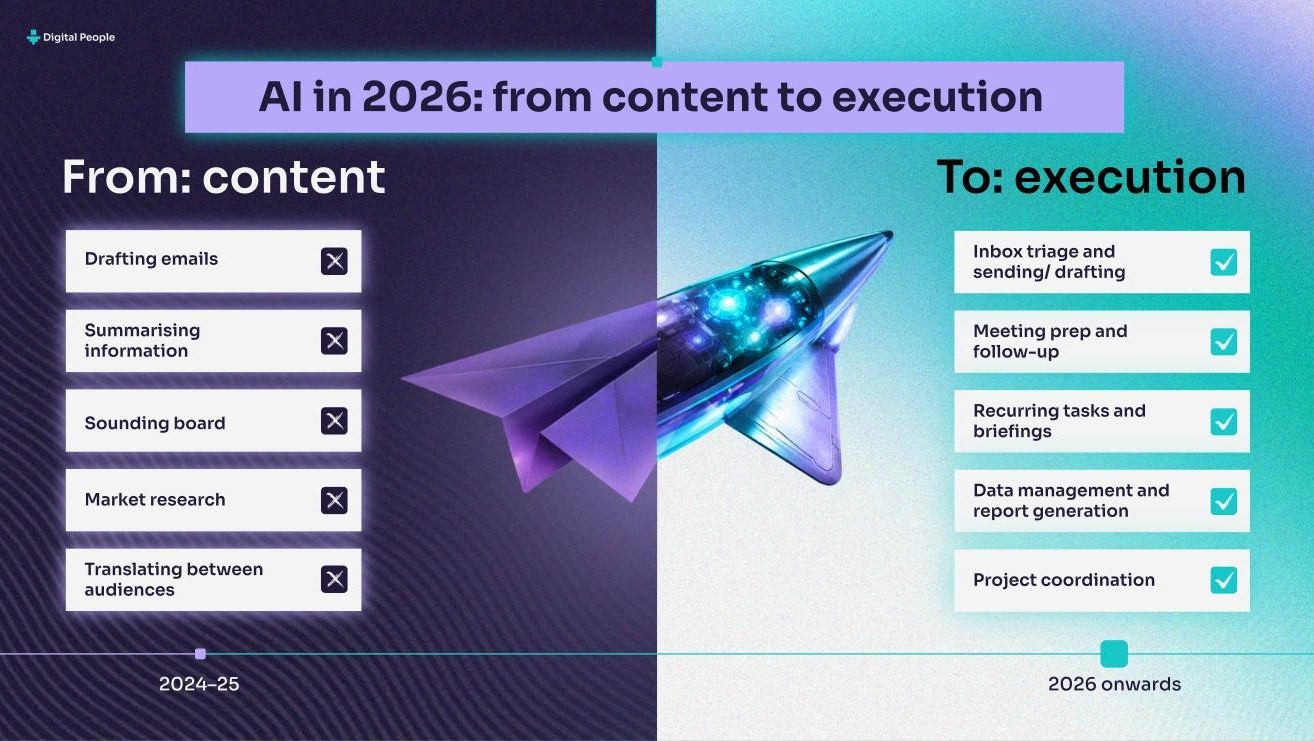
Content
- Drafting emails
- Summarising information
- A sounding board
- Market research
- Translating between audiences
Execution
- Meeting prep and follow-up
- Recurring tasks and briefings
- Data management and report generation
- Project coordination
- Inbox triage and drafting replies for you to approve
A new untrained intern. Every morning.
Twenty minutes explaining who you are, who your audience is, the voice you want and the things they should never do. Then the actual work. Tomorrow morning, the same conversation.
Train once. It remembers.
Same job, same rules, same memory, the morning after and the morning after that. The intern you only have to train once.

What is an AI agent?
An AI you have trained for one specific job. In practice it is a page of written instructions, plus the files and memory the assistant keeps alongside them. It reads that page every time, so you explain the job once, and it does that one job a little better every time you tell it what to improve. No code, no engineers. If you can describe the job to a competent new hire, you can write the page.
Six reasons agents win. Each is useful on its own; together they compound.
One job done well. Never distracted.
It remembers your style, your audience, your people.
Learns to sound like you, not like an AI.
Rules set once. They stick.
Connected to your calendar, email and files.
Tightened weekly. Better every year.
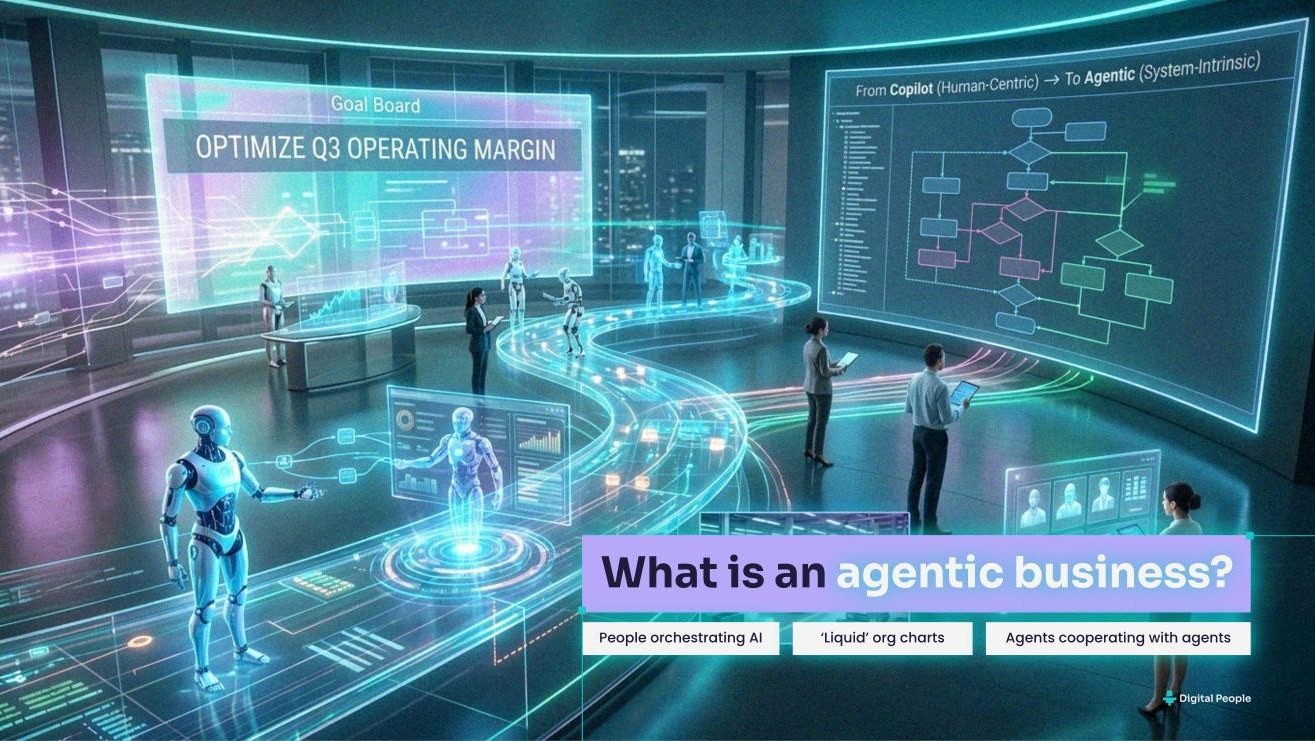
An agentic business is one where agents do the work and people set direction, brief and check. Teams form around tasks rather than fixed reporting lines, and agents hand work to other agents, with a named human accountable for each outcome. It starts with one leader building one agent.
Lead from the front
Why leaders have to go first
You will be asked to approve the AI strategy, the budget and the risk. You cannot judge any of them well from a slide deck.
My view, not a statistic. It is the minimum for a leader who wants to be ahead, not average: building, managing and improving agents on your own work.
a week: how long the average executive spends using AI. Only 7% spent more than 5 hours.
Yotzov, Bloom et al., NBER w34836, revised October 2026; 7% from its early 2026 survey.
I read the gap between the 80% and the 37% as a leadership gap. Individuals get faster on their own; the organisation only gets better when someone redesigns the work. That someone is you. And your people copy what you do: use an agent openly, show your drafts and admit what went wrong, and you give everyone permission to try. Hand AI to IT alone, and they learn it is something done to them.

The map for the rest of this page
The five shifts of an agentic leader
What changes in your job. Each shift links to the section that covers it.

- Be an AI power userAt least 5 hours a week, building and working with agents on your own work. You cannot design work you don't understand. Build your own
- Redesign the workWhich tasks are human, which are agent, and how do the two work together? Redesign the work
- Plan it in publicA change programme your people can see and shape. 8 steps to an agentic company
- Take the team with youTeach it, learn together, and correct course as you go. Take the team with you
- Make it systematicA route for good ideas to become firm-wide improvements, and the habit of writing every lesson back into the agent. Your commitment
Shift 1 is the one you can't delegate.
Redesign the work
You inherited one org chart. You now design a second.
Org design is one of the biggest drivers of productivity, and AI changes what it means.
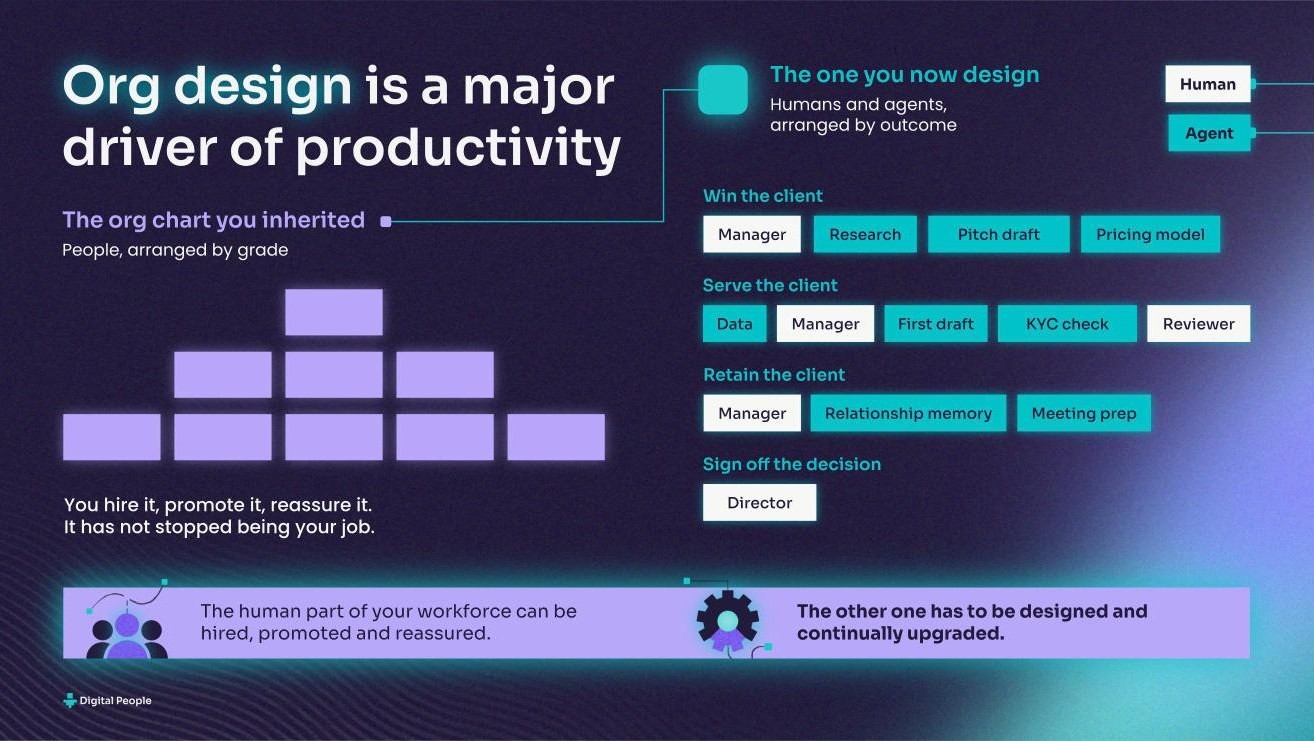
People, arranged by grade
Hired, promoted, appraised and reassured. You know how to run this one. It has not stopped being your job.
Humans and agents, arranged by outcome
Each outcome (win the work, do the work, keep the customer) has a human owner, the agents that do the steps and a human reviewer. It is never finished: it has to be designed and continually upgraded.
Sort every task into three piles
Do this with your team, one process at a time. It is the fastest way to find where agents belong.
High volume, low stakes, easy to reverse: sorting, summarising, first research, routine updates.
Anything that goes out under your name or changes money, plans or priorities.
Judgements about people, relationships that matter, and anything you could not take back.

The compounding-error test. If each of 3 steps in a chain is 70% reliable, the chain is only 34% reliable (0.7 x 0.7 x 0.7). Before you link agents together, make each step reliable, or put a human check where the errors would compound.
Build, Buy, Borrow or Bot
For every recurring task, decide who or what does it. Build it in your own team. Buy it from a vendor. Borrow fractional or contract talent. Or hand it to a Bot, an agent you have trained. The mix of full-time, fractional and agent is now a design choice, not a default.
Orchestrating, not doing
People set direction, brief and check, while agents do the doing and hand work to other agents. The question moves from how many people you need to which skills. Your job shifts from managing tasks to designing the system that does them.
Take the team with you
A first month for a leadership team
Gartner expects over 40% of agentic AI projects to be cancelled by the end of 2027, on escalating costs, unclear business value or inadequate risk controls, and warns that many use cases never needed an agent (press release, 25 June 2025). The antidote is a short, visible plan that starts with the leaders, picks tasks that genuinely need an agent, and gives each one a number.

- Week 1: you build 2Set up Claude with my step-by-step setup guide, then build two agents from my guides: a daily calendar brief and an email assistant. About 3 hours, on an account IT has approved. If connectors are not approved yet, start with agents that only need documents you paste in. For anything else, use the six-part prompt.
- Weeks 2 and 3: the team builds 1 eachEach member of your leadership team picks a guide, builds it on their own work and shows the team what changed.
- Week 4: keep the best 3Turn them into shared agents, each with a named owner, a short job description and data rules.
- After that: roll out with rulesApproved tools on a company account, short rules people remember, and a monthly review of what is running.
Make it stick
- Baseline first. Write down how long the task takes today, before anyone builds anything.
- One number per agent. Minutes saved, turnaround time or errors caught. One, not five.
- Check in at 10 to 14 days. In my experience, most agents are good after 3 to 5 runs with clear feedback. Most drop-off happens before that.
- Ask what you will stop doing. Time saved only counts once you decide where it goes.
- Run "show me yours". 30 minutes, everyone demos one agent. It beats an hour of slides.
- Say what happens to jobs. Tell people early where saved time goes. Silence is read as cuts. Bring HR in early: in the UK and Europe, consultation duties may apply.
- Design for mixed ability. Make the first 5 minutes hands-on, and pair your fastest builder with your most sceptical senior person.
- Judge the decision, not the cleverness. What matters is the decision the agent helped make.
The delegation ladder
- AskYou ask AI a question, and start from scratch every time.
- BriefA standing brief in a project, so it remembers who you are.
- ConnectIt reads your diary, inbox and files, and drafts from them.
- ScheduleIt runs before you ask, and you review the results.
- SuperviseYou manage a team of agents, each with one job and an owner.
In my experience, most leaders are on rung 1. My step-by-step agent guides can get you to rung 4 within a week or two. Rung 5 is where the organisation changes.
Governance and the organisation
You can get AI governance wrong at both ends
In my experience advising more than 50 companies, firms that ban AI rarely have fewer incidents. They just see fewer, because caution breeds shadow AI: staff using AI on personal accounts where nobody can see it.
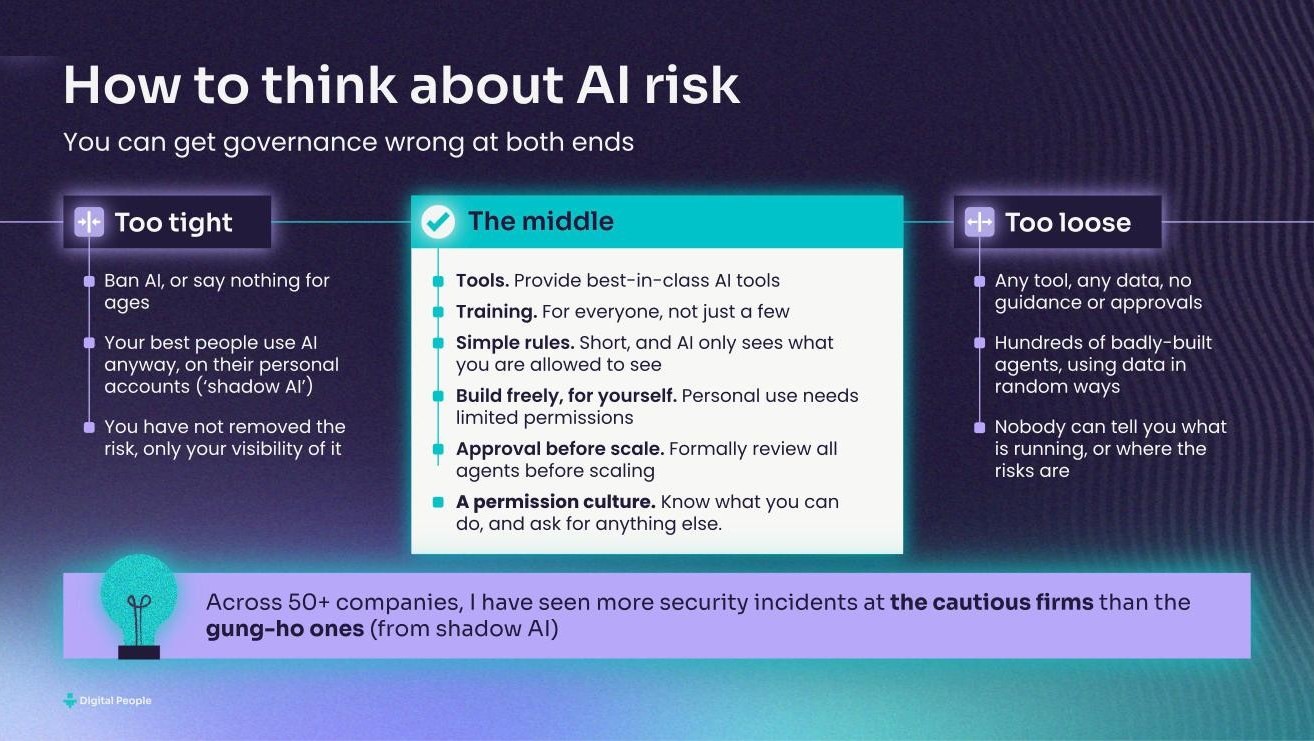
Ban it, or say nothing
- Your best people use AI anyway, on personal accounts
- You have not removed the risk, only your visibility of it
- Your most capable people learn fastest, outside your walls
Where to aim
- Best-in-class AI tools, provided on company accounts
- Training for productivity and for governance
- Simple rules, short enough to remember
- Build freely for yourself, on approved tools: personal agents may read and draft, but should not send, pay or publish without a human
- Approval before scale: every agent formally reviewed, with IT, security, data protection and HR, before it goes firm-wide
Any tool, any data
- Hundreds of badly built agents, using data in random ways
- Nobody can say what is running, or where the risks are
- The first incident becomes the reason to swing to "too tight"
You own what your bot says
Air Canada's website chatbot told a grieving customer he could claim a bereavement fare after travel. The real policy said before. In February 2024 a Canadian tribunal held the airline to the chatbot's answer. Air Canada argued it was not liable for what its chatbot said, which in effect treated the chatbot as a separate legal entity; the tribunal called that "a remarkable submission". The award was just C$812.02. The money was never the risk. The risk was arguing that the machine was responsible. Nobody wrote that policy, and it still bound the company.
Regulators expect human review to be real: the UK ICO says it must be meaningful, not a token gesture. The rule: keep a human on every decision about a person, and free up the routine.
Moffatt v. Air Canada, 2024 BCCRT 149.
Where the data actually goes, and what a prompt can't do
- Location. On every Claude tier your data is stored in the US, and by default a prompt may be processed wherever is fastest, so UK and EU personal data is transferred abroad either way. Enterprise can pin processing to the US and adds audit logs: a stronger contract, not a European one. Checked September 2026.
- Special-category data (health, ethnicity and the like) stays out of prompts until legal have signed it off.
- Prompt rules are not a technical lock. "Draft, never send" in an agent's instructions is good practice, not a control. The controls are what the platform allows: connectors with the least access the job needs, read before write, and a human approval step for anything that sends, pays or deletes.
- Agents that read email or web pages must treat what they read as information, never as instructions. Build that line into every agent that reads outside content.
Bots as colleagues
Your newest colleagues are bots: 8 questions to answer
Agents are joining faster than your policies were written for them. Every leadership team now needs answers.

Every agent needs a named human owner. If nobody can say whose it is, it should not be running.
At the second user. That is the moment it needs approval, a short job description and data rules.
Yes, and often. Its users review it, and an agent that underperforms gets fixed or retired.
They have created a new colleague. Recognise it, or your best builders will stop sharing.
A ghost agent with no owner keeps running. Make agent handover part of every leaver checklist.
The prompt, its memory and the data it built up. Your employment and supplier contracts probably do not say.
A small team of people can now run many agents. Show them, so you can see what the team really does.
Built in London, using German data, running on US servers: where does it work? Ask legal and tax before you scale it.
4 tests before an agent becomes an official company bot
Anyone can build for themselves. Before an agent becomes a shared company bot, it should pass all four.
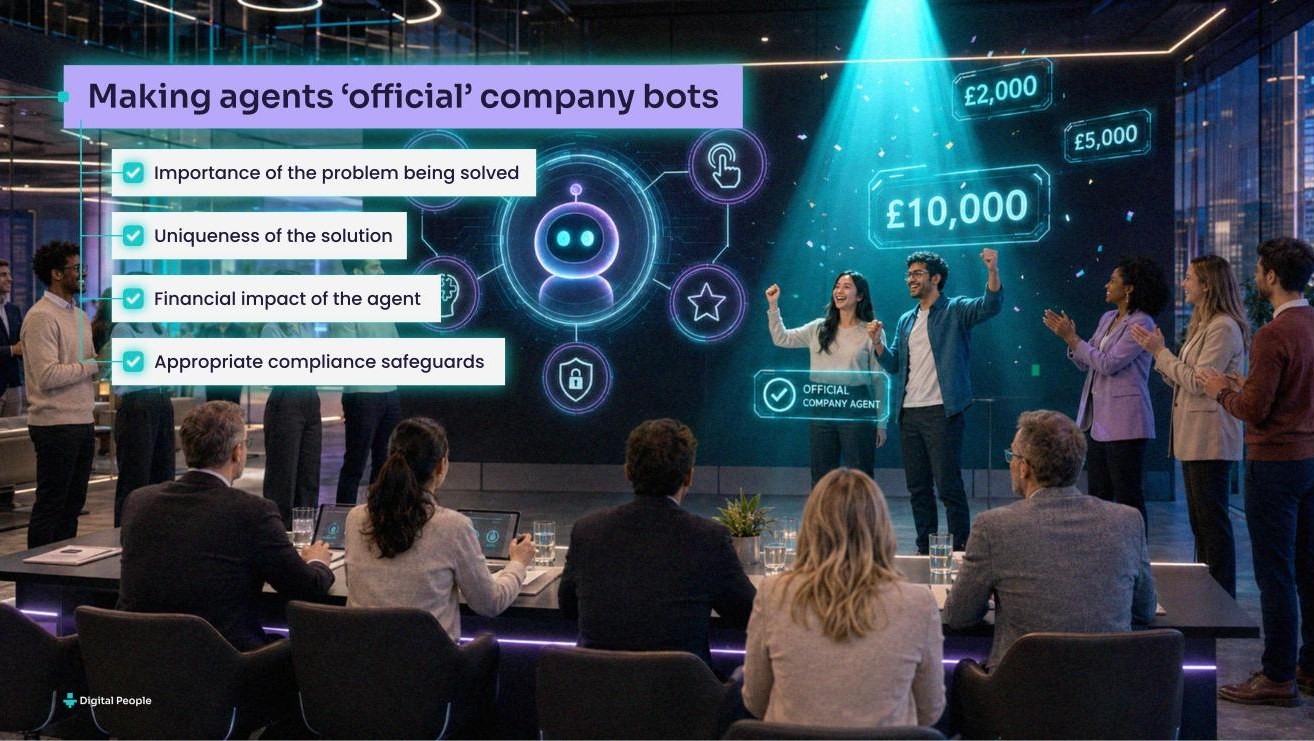
Is this a real bottleneck for real people, or a clever demo?
Does it do something the existing tools and vendors do not, or do badly?
Hours saved on their own are a vanity metric. Decide where the hour goes before you save it.
What data does it read, what can it change, and who checks it? See Quality below.
Making your company agentic
8 steps to an agentic company, then 6 numbers for the board
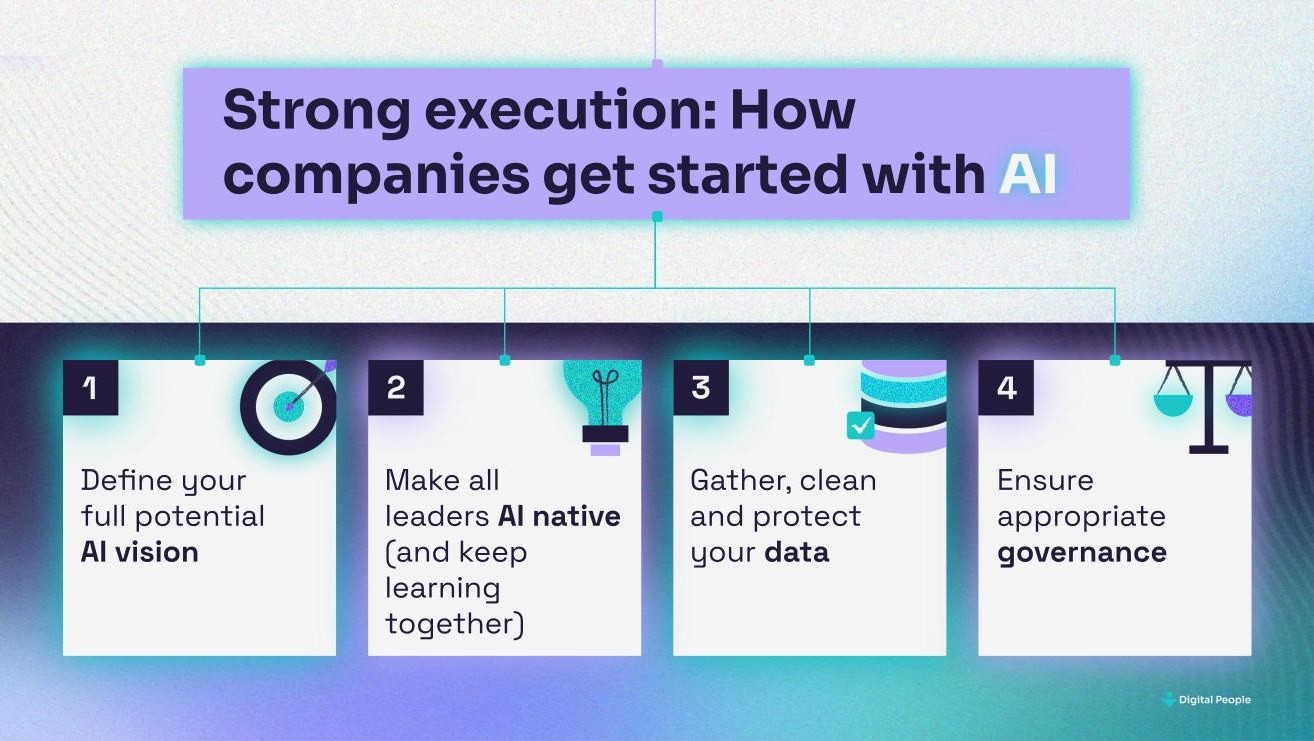
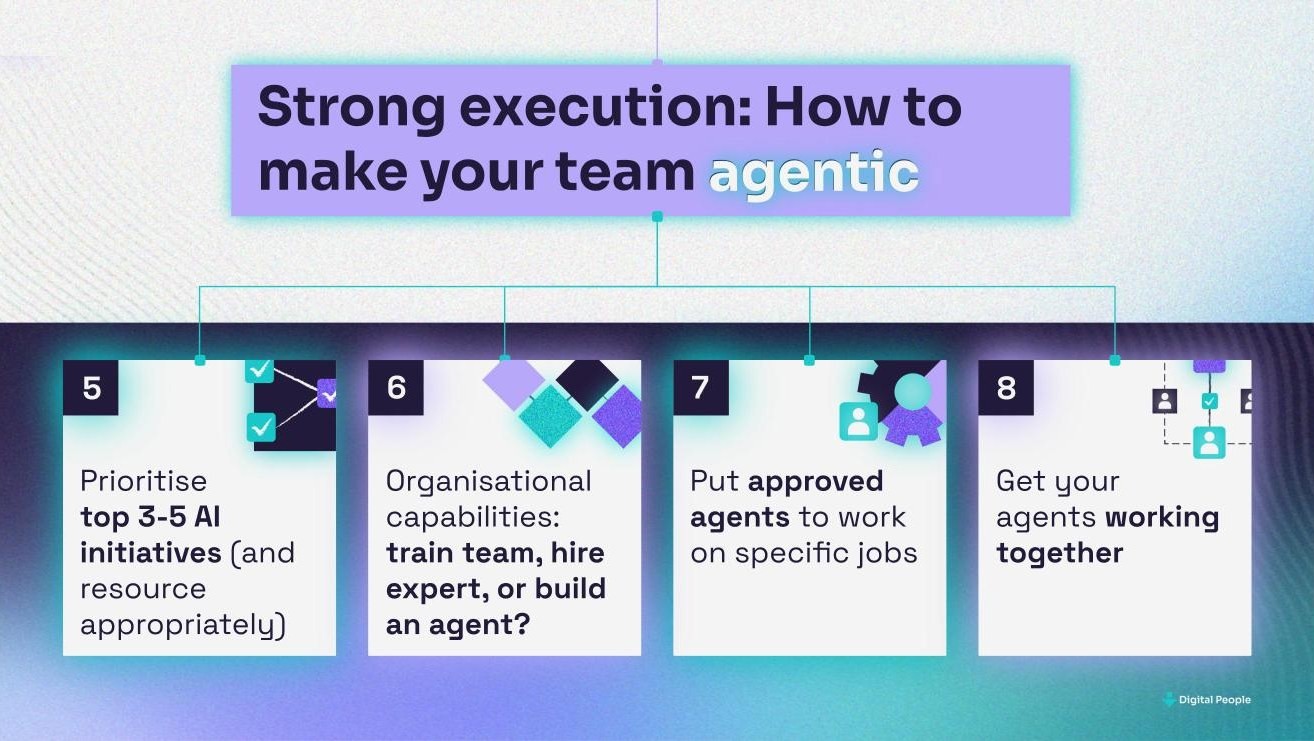
Personal agents get you fluent. Company-wide execution is a different job, and it is yours. 8 steps, in 2 halves.
Get started
- Define your full-potential AI visionWhat the business looks like when agents do the work.
- Make all leaders AI nativeAnd keep learning together, where your people can see it.
- Gather, clean and protect your dataAgents are only as good as what they can read.
- Ensure appropriate governanceNeither too tight nor too loose, with IT, security, risk and HR at the table.
How to win
- Prioritise the top 3 to 5 AI initiativesAnd resource them appropriately.
- Train the team, hire an expert, or build an agent?Build, Buy, Borrow or Bot: decide who or what does every task.
- Put approved agents to work on specific jobsOne job each, done well.
- Get your agents working togetherAgents handing work to agents, with a human owner for each outcome.
Measure what matters: 6 numbers for the board
Executives, managers, front line. Leaders first.
Minutes saved (and where they went), turnaround or errors caught, against its baseline.
Errors caught, and errors that got through.
Customers, growth, or simply gone?
Every shared agent, with its owner.
Licences and usage per shared agent, against the value of the time it frees.
Two early examples worth knowing
Gave its wealth advisers an AI assistant over its own research. Over 98% of adviser teams use it.
OpenAI case study, 2024.Moved routine customer questions to its chatbot, Billie, then retrained 8,500 call-centre staff as remote interior design advisers. Growth, not just cost.
Reuters, June 2023.Build your own: shift 1 in practice
The six-part agent prompt
Use it for every agent you build. Describe the job out loud, using the microphone in Claude, as if briefing a new hire. Six parts, six short lines: that is your first draft.
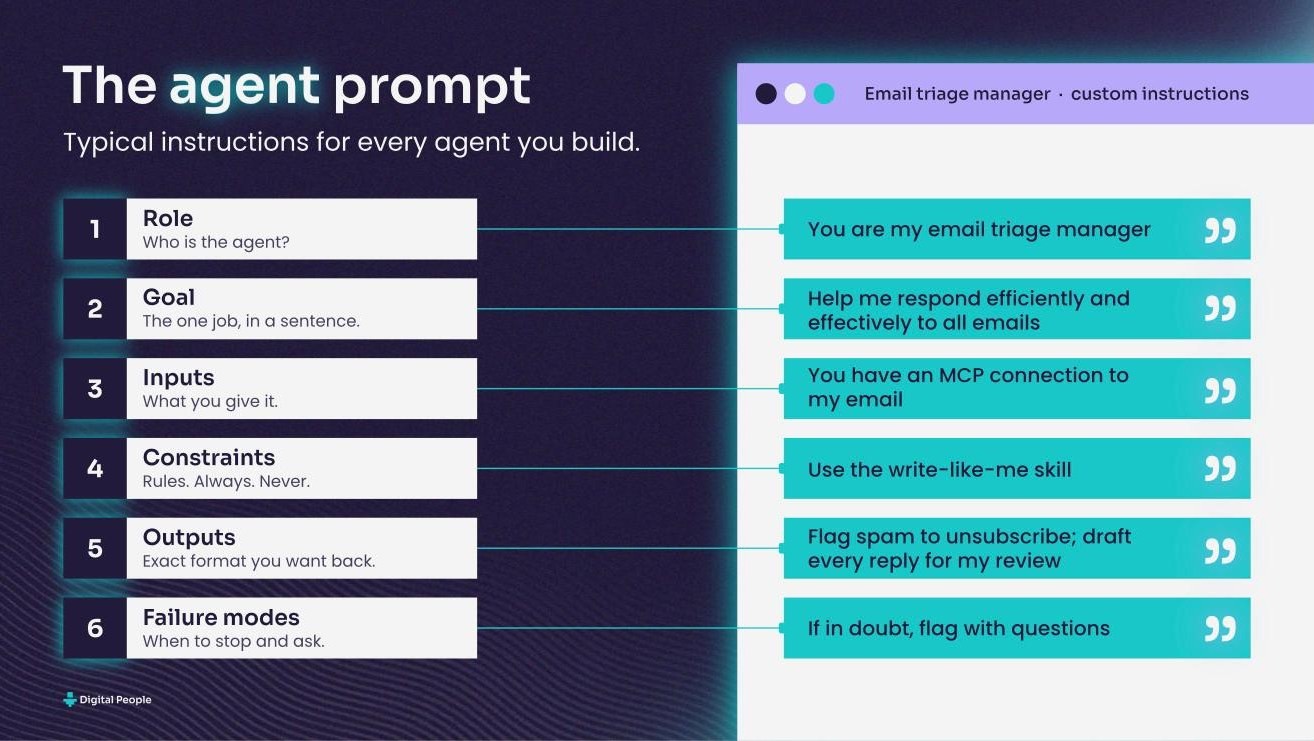
| Part | What it is | Example: email triage |
|---|---|---|
| 1Role | Who is the agent? | "You are my email triage manager" |
| 2Goal | The one job, in a sentence | "Help me respond efficiently and effectively to all emails" |
| 3Inputs | What you give it | "You are connected to my email" |
| 4Constraints | Rules. Always. Never. This is where the value is | "UK English. Warm but brief. Never invent." |
| 5Outputs | The exact format you want back | "Flag spam to unsubscribe; draft every reply for my review" |
| 6Failure modes | When to stop and ask | "If in doubt, flag with questions" |
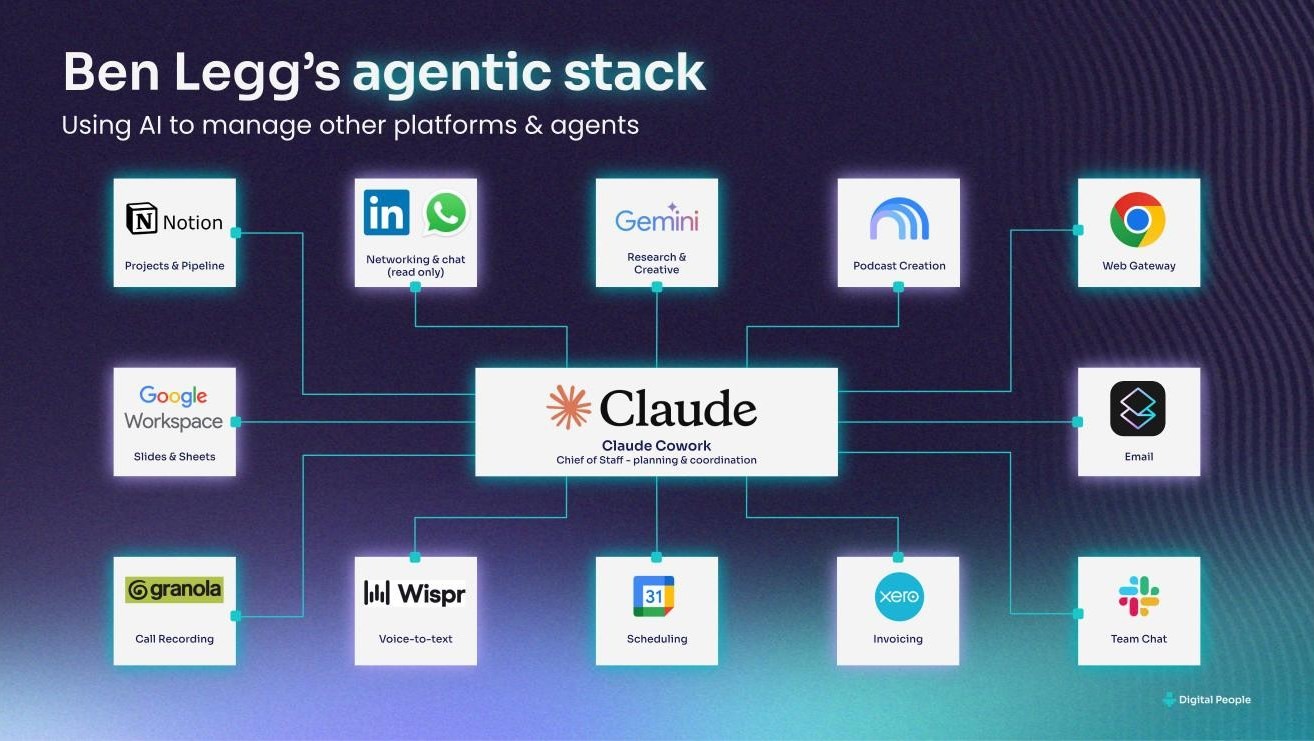
Ready to build? Pick a guide: each agent takes under an hour once Claude is set up.
Quality
How do you know an agent is good enough to trust?
Everyone builds the agent and forgets the harness: the set of checks around it that catch mistakes before they matter. Four questions, each one a check. One check on its own is theatre; a harness has several.

If not, write the standard into it. Nothing else works without it.
Then put it in a Skill, so it follows you into every project and chat.
Then a second agent marks it, with a different prompt and the standard written first. Never the one that wrote it, and in my experience never a cheaper model than the one that did the work.
If not, it stops and you look: sending, paying, publishing, deleting.
An agent marking its own homework gives itself an A: peer-reviewed research (Panickssery et al., 2024) shows AI graders favour their own output. And if your agent has never stopped and asked you something, it is not being careful. It is being confident.
Your commitment
What will you do differently?
Not a strategy. A named task, done by Friday. Then a short list for your team this quarter.
For you, this week
- Work through stage 1 of the setup guide: the right plan, your calendar and email connected
- Build the calendar brief, then the email assistant
- Use your voice instead of typing for one full day
- Write the six-part prompt for one agent of your own
- Block 5 hours a week in your diary for building and improving agents, starting with a 20-minute Friday review: ask your most-used agent what it got wrong this week, and add one line to its instructions
For your team, this quarter
- Run the first month with your leadership team
- Sort one core process into green, amber and red
- Agree your simple rules for personal agents versus official company bots
- Give every shared agent a named owner and one number
- Name your company's top 3 to 5 AI initiatives
- Add the four harness checks to any agent that sends, pays or publishes
- Which of us will build first, and show the others?
- Which process do we sort into green, amber and red first?
- What are our rules, short enough to remember?
- Who owns each shared agent, and how do we review it?
- Where will the time we save go?
Bring it to your leadership team
A hands-on workshop for your top team
I run this playbook as a hands-on workshop for C-suites, boards and senior leadership teams, in person or online, from 2 hours to a full day. Each one is designed around your team and the decisions in front of it. Everyone builds; nobody just watches.

Pitched at your level
- A short survey of who uses which AI tools today, so the session fits your team and I can recommend a set-up
- A call to pick the processes and questions that matter most to you
Mixed ability, by design
- Some people build their first agent; those already building get better set-ups and ideas they hadn't thought of
- Everyone's personal AI set-up connected and working
- The green, amber and red sort on one of your real processes
- Your rules for personal agents and company bots
- Optional: a module on your own context, such as a regulation, a function or a client challenge
Working agents and a plan
- Everyone: a working AI set-up and at least one agent built on their own work
- The team: a green, amber and red map of one process, a first month with owners and one number per agent, and draft rules to take to IT, HR and risk
"He translates major technology shifts into clear, actionable priorities, delivered with genuine energy and passion for the topic."
Richard Barltrop, Director, Private Equity, CVC"Ben's insights on AI are unique and highly educational, and his suggestions for how we can all embrace AI were pragmatic."
Lee Dawes, Chief Operations Officer, Drax Group plc"He delivered a great blend of visionary insights and 'step-by-step' pragmatic recommendations that landed well with our leadership teams."
Mark Shraga, Chief Sales and Marketing Officer, Southern Communications GroupClients include AstraZeneca, Haleon, Tesco, Deloitte, Novo Nordisk, CVC and DHL. Workshops are built and tested on Claude; the leadership content works on any platform, including Microsoft Copilot.
Take it with you
The Agentic Leader Playbook, as a PDF
The same playbook in 22 pages, to print, email or read offline. It also covers where an agent lives, connectors, choosing a model, troubleshooting and a 25-term glossary.
Part of a growing series
Gemini Notebook is Google's tool formerly called NotebookLM. The notebook is read-only; open it with any Google account. Independent and not sponsored by Google or Anthropic.
Questions people ask
The Agentic Leader FAQ
What is an agentic leader?
A leader who builds and works with AI agents personally, then redesigns how their team or company works around them. In practice that means 5 shifts: become an AI power user, redesign the work, plan it in public, take the team with you and make it systematic. The first shift, at least 5 hours a week of hands-on building, is the one you can't delegate.
Who is responsible if an agent gets it wrong with a client?
You are, exactly as with a junior colleague's draft you signed off. That is why the harness puts a human at the point where money, reputation or data leaves the building, and why "draft is not send" is the rule to remember. Customer-facing bots bind you too: Air Canada was held to what its chatbot told a customer.
Does it only work with Claude?
No. The leadership chapters (going first, redesigning the work, taking the team with you, governance and measurement) apply on any platform, including Microsoft Copilot. The build chapters are written around Claude, because that is my own stack. If your company runs on Microsoft 365, start where your data and admin controls already are, and ask IT which parts your platform can do today. One thing to know: an admin can choose Claude as the engine inside some Copilot features, which gives you Claude's brain in Microsoft's product but not Claude's projects, skills, connectors or scheduled tasks.
Where does my data go?
To the AI provider's servers, where the model runs. On Claude's Free, Pro and Max plans, switch off "Help improve our AI models" in Settings, then Privacy, and your chats are not used for training. Chats are then kept for 30 days. Team and Enterprise are never used for training. For company data, use the plan and connectors your company has approved, and keep special-category data out of prompts.
Insights and advisory services from a battlefield-tested operator and ex-COO of Google Europe, Ben Legg.

© 2026 Digital People. All rights reserved.